
Your school’s own system, on your own server
Admissions to results, fees to payroll, and a Bengali app in every guardian’s hand. One school, one deployment, one database — and it is yours, not a row in somebody else’s.
The School owns it
Most school software puts every customer into one database on one server, and calls the row you occupy your account. This does not. Your school gets its own deployment, its own database and its own domain — and the fee money goes straight from the family to your bank, because the merchant account is yours, not ours.
Fees move from the family to the school. Three parties — and S3 Solution is not one of them.
We supply and maintain the software on a machine the school pays for. There is no line from this row to the one above it.
No shared server, ever
One school, one deployment. There is no multi-tenancy to leak between customers, and no central server that knows your school exists.
Not locked to a host
The stack is ordinary — Linux, PostgreSQL, nginx. Moving to another provider is about an hour’s work plus DNS, and you can ask anyone to do it.
A licence to run it, not a sale of the software
The source code stays with S3 Solution — better said plainly here than discovered in a contract. What is yours is the deployment, the domain, the database, and every byte in it.
Six areas, one database
Named for the job rather than the module. Everything below shares one database, so a fee waiver, an absence and a term result belong to the same student — not to three spreadsheets that quietly disagree.
Academics and the year
Versions, classes, sections, subjects and groups. An academic calendar that closing days actually obey. And one action that copies a whole year’s setup into the next.
Results
Class tests, tutorial and term exams weighted per subject, grading scales and GPA, report cards, admit cards, and a tabulation sheet that ranks the class.
Attendance
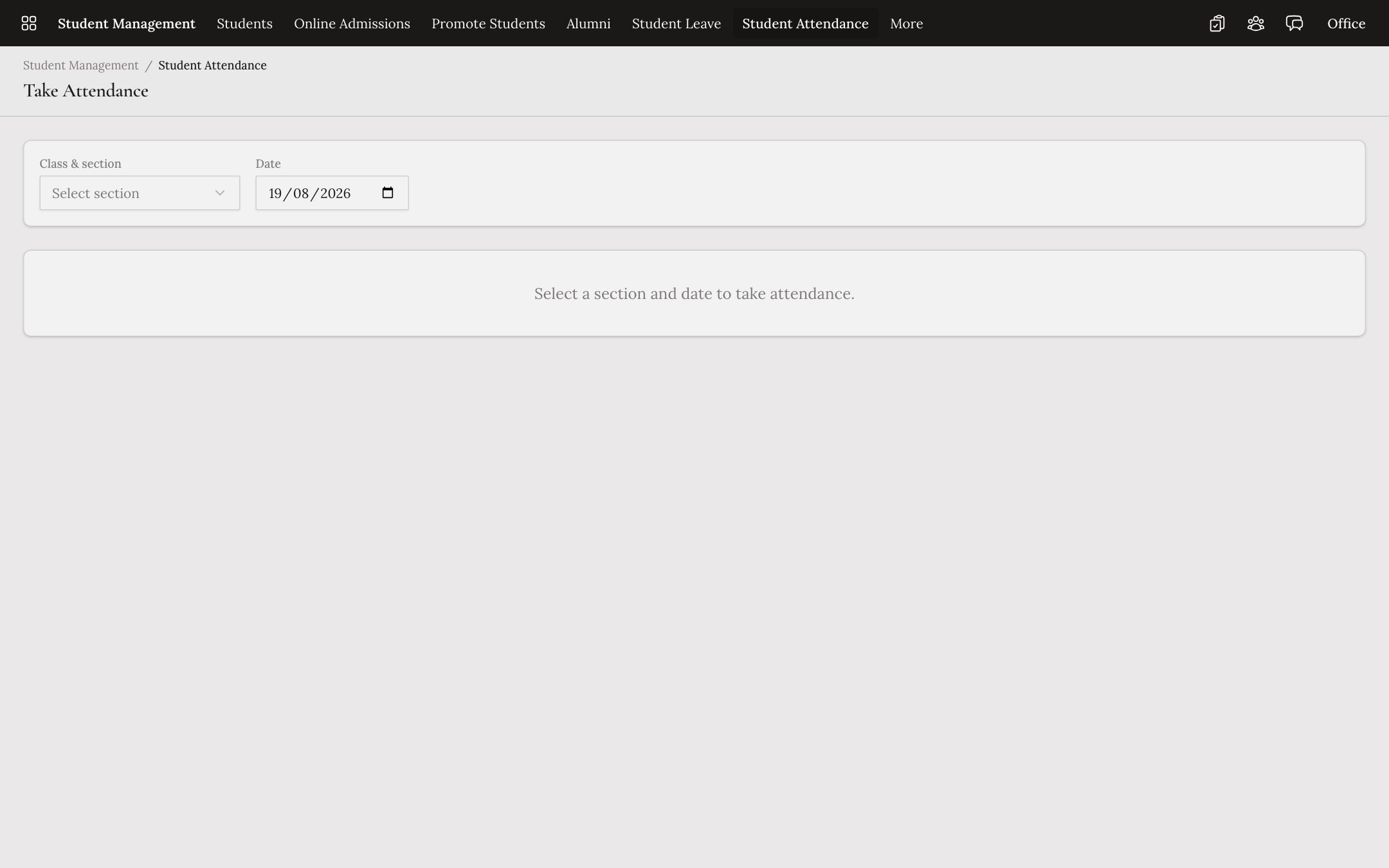
Students marked against the calendar and against approved leave. Staff attendance derived from biometric punches rather than typed in by whoever is asked.
Fees and accounts
Fee heads, structures and waivers. Invoices and numbered receipts. Dues and arrears aging with reminders. Every collection posted to the ledger as it happens.
Guardians
A portal and an Android app in Bengali, threaded messages to the office, SMS and push — so the family is inside the system rather than ringing about it.
Staff and payroll
Records, leave, substitutions and the organogram. Salary structures and staff loans. Monthly runs that post payslips into the ledger and know who was absent.
And the other thirty-odd modules ↓
- Admissions
- Recruitment
- Library
- Inventory
- Stationery shop
- Front office
- Enquiries
- Visitors book
- Phone log
- Gate passes
- Parent–teacher meetings
- Approval chains
- Timesheets
- Task board
- Discussion board
- Blog
- Olympiads
- Alumni
- Health records
- Conduct notes
- Homework
- Learning materials
- Document templates
- ID cards
- QR verification
- Document archive
- Statistics returns
- Executive summary
- Performance analytics
- Teacher KPI
- Audit log
- Backups and retention
- SMS campaigns
- School website
Real, documented and included — but a landing page that gives them equal billing buries the six above.
Guardians read it in Bengali
A system the office likes and parents cannot read is half a system. The guardian side is Bengali the whole way down — not a translated menu sitting over English data, but the sentences the server itself writes, the notifications that reach a phone, and the error under a form field when something is filled in wrongly.
Where it reaches
- The guardian portal and the Android app
- Messages the server writes — approvals, refusals, confirmations
- Push notifications, in the recipient’s own language
- Validation errors on every form a guardian fills in
- Eight of the guardian SMS templates, by default
4 জানুয়ারি 2027 — Bengali words, Western digits. A date written the way a Bangladeshi parent actually reads one, which is not what a stock date library hands you.
What is not translated
Printed report cards, admit cards and receipts stay in English — they are official documents and must match the school’s own records. So do the public website and the login screen. The staff side is English by construction: an office account cannot render Bengali even if someone tries to set it.
The screens that decide things
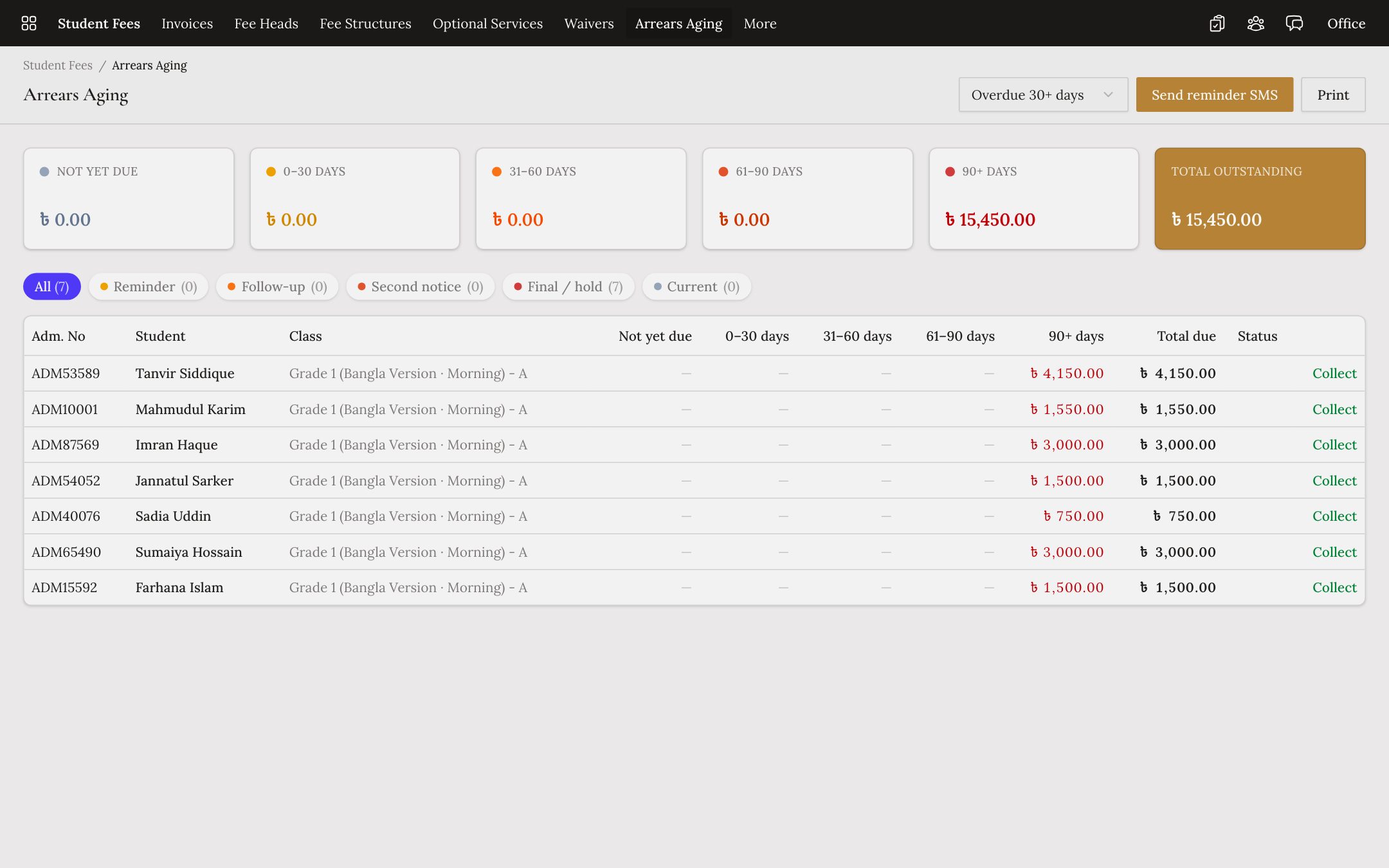
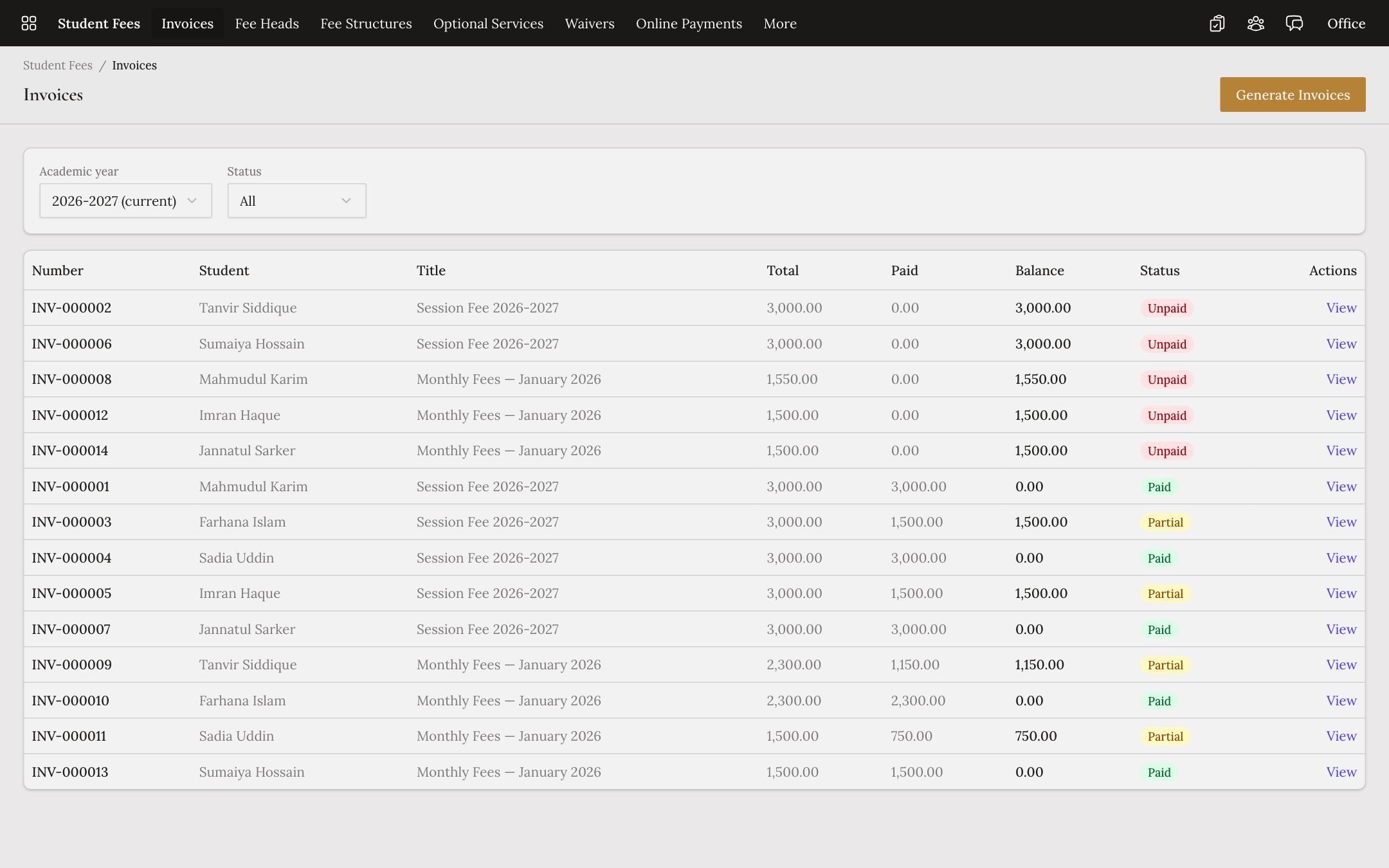
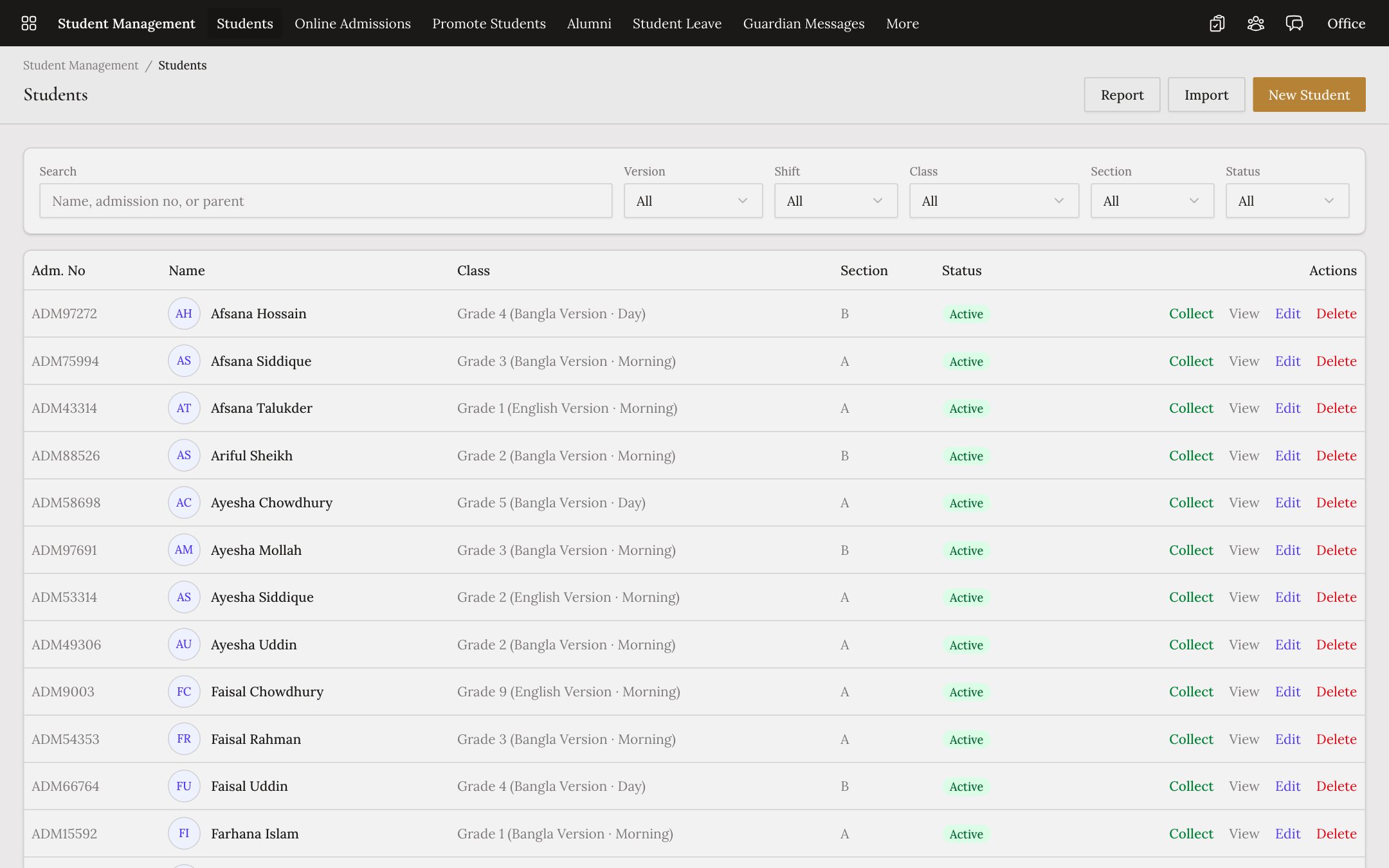
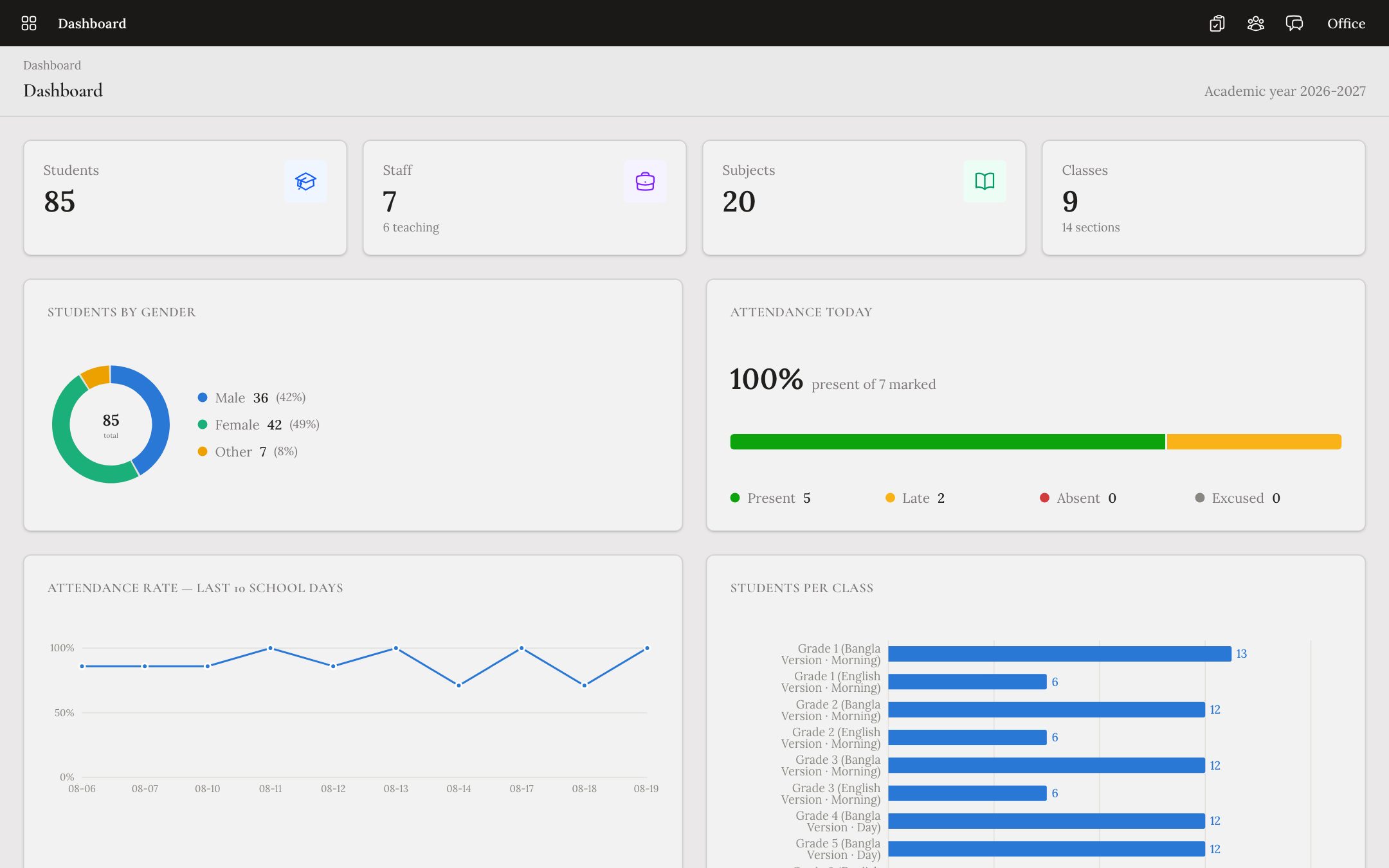
Captured from a seeded demo database, never from a customer’s data.
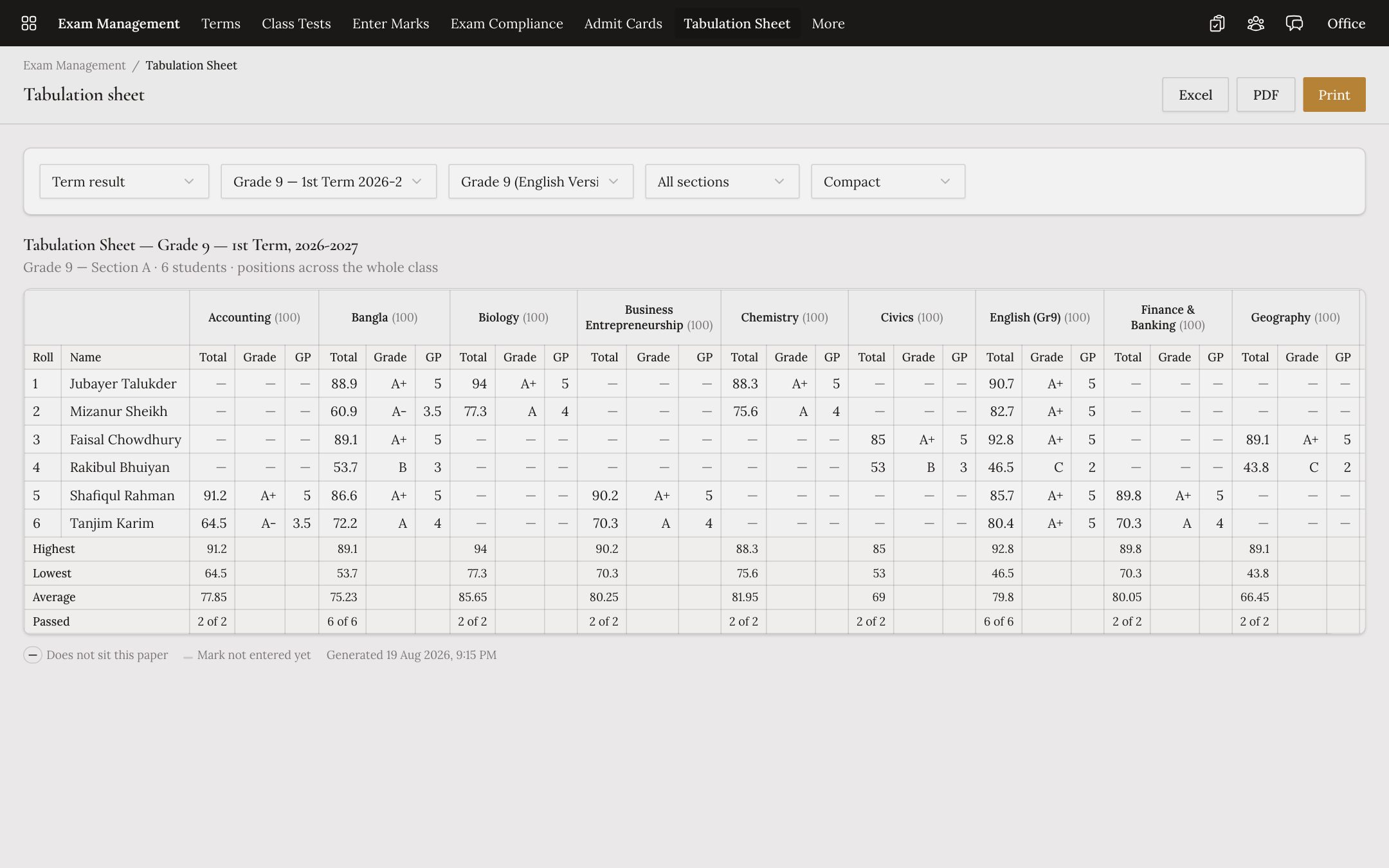
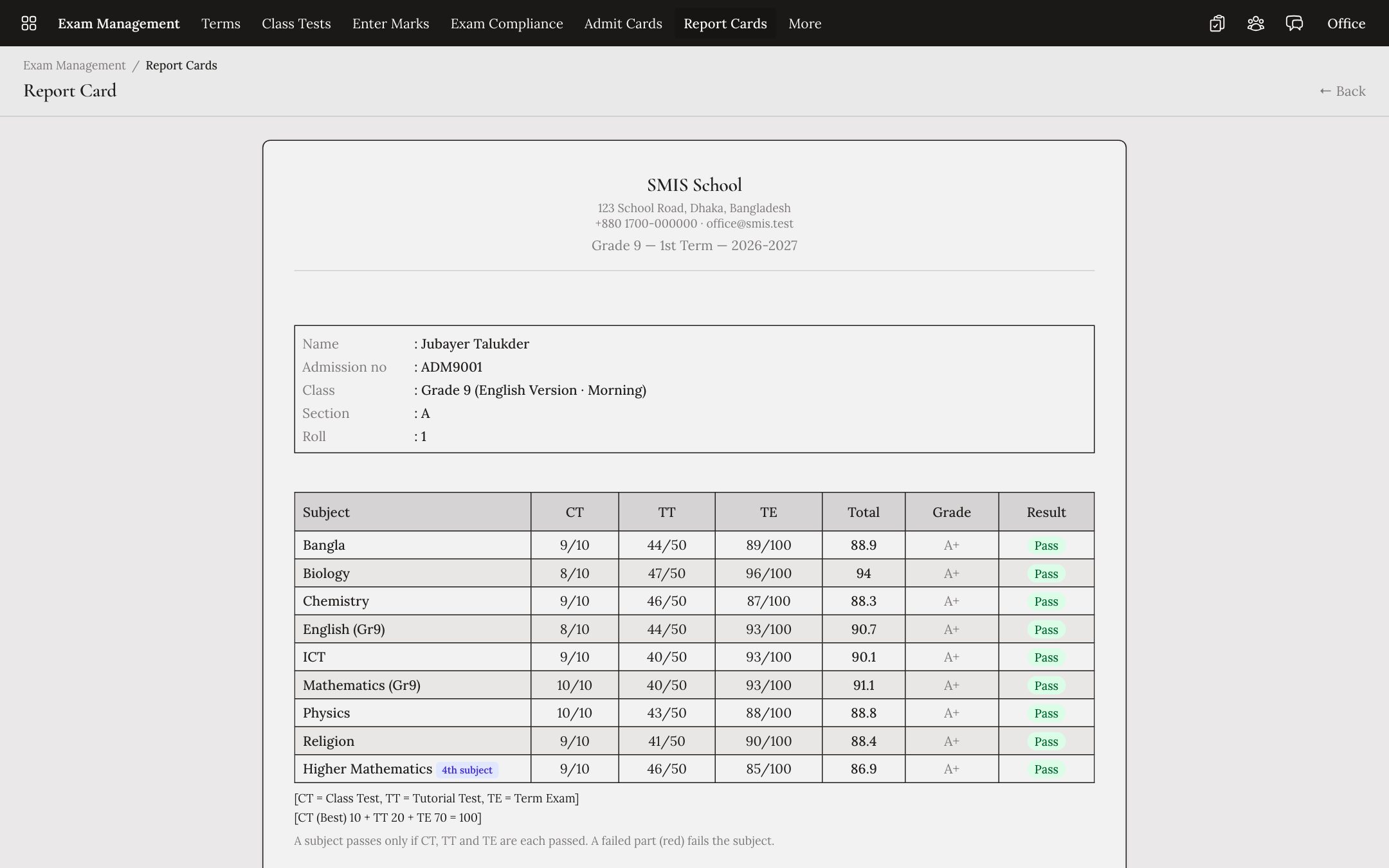
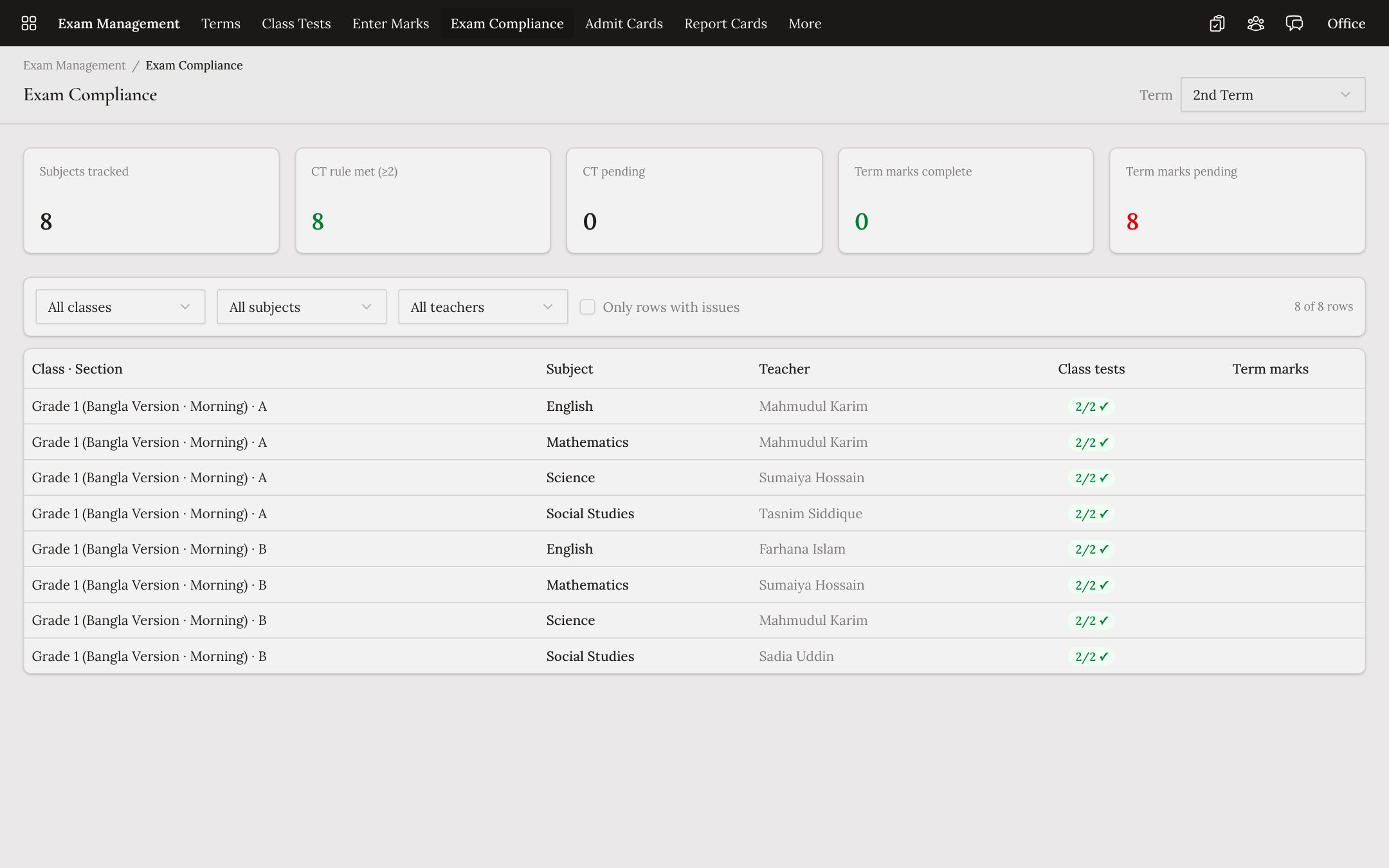
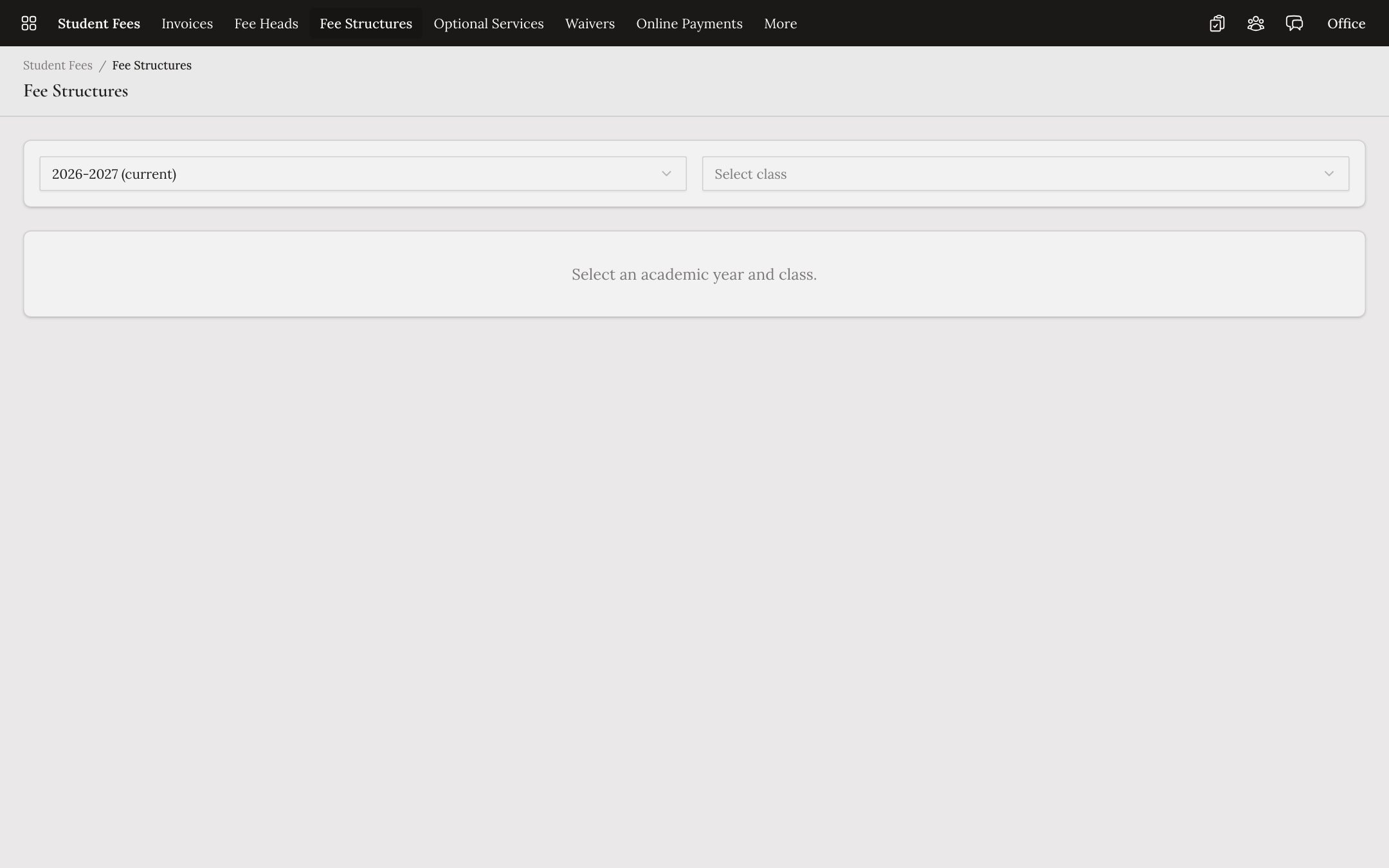
A paper you did not sit should not cost you marks
Suppose a subject runs no tutorial test this term. Most school software still marks it out of 100, leaving 20 marks nobody could ever have earned — so every student in that subject loses a fifth of the grade for a paper the school chose not to hold. Here the subject is marked out of 80, because a part that was not run is left out of the total rather than scored zero.
Weighting is configuration, subject by subject
Class test, tutorial and term exam carry the weights your school actually uses, and they can differ between subjects. A subject adding up to 130 raw marks is converted back to 100, so grades and GPA stay comparable across the class.
Religion papers, sat by the right students
A faith paper is taken only by students recorded in that faith, so a Hindu student is not counted absent from Islam and Moral Education. A student the rule cannot place is named on the compliance screen rather than quietly left without a subject.
The fourth-subject rule, applied for you
For classes IX and X the optional subject follows the board rule on its own: it lifts the GPA where it should, and stays out of the total where it should not.
Nothing publishes with marks missing
The compliance screen names every subject still short of marks, and results cannot be published past it. What that prevents is a report card that looks complete and is not.
Attendance taken where there is no signal
A teacher standing in a classroom with one bar of signal is the case that breaks most school apps. Here the write is queued on the phone and replayed when it reconnects: the teacher marks the register, closes the app, and it lands when the network comes back.
- Two faces, one app
- Teachers get the register, marks, their routine and their leave. Guardians get results, attendance, fees, the calendar and messages from the office. Same install — it decides by who signs in.
- Bengali for the family, English for the staff
- The guardian side follows that account’s own language setting. The teacher side stays English.
- Android today
- Installed from a link the school sends out, or with your own Play listing and icon if you want it branded. There is no iOS build.


Fees, from the structure to the ledger
Fee heads and structures per class and year, waivers per student, invoices raised for a whole section at once, and a numbered receipt at the counter. Every collection posts to the ledger as it happens, so the day book is right without anyone copying figures into it.
Dues that chase themselves
Arrears aged into 30, 60 and 90-day buckets, with reminder SMS that escalate. The office stops discovering a year-old balance at admission time.
Direct bKash, not only an aggregator
Pay through SSLCommerz, or through bKash directly — directly meaning the school pays bKash’s own rate rather than an aggregator’s cut on top. Gateway credentials are encrypted in the database and edited on a settings screen, never left in a file on the server.
Paid once, even when the gateway says twice
A payment records itself, issues its receipt and posts to the ledger exactly once, however many times the gateway repeats the callback.
Payroll that knows who was absent
Salary components, staff loans recovered from pay, and monthly runs that post payslips into the same ledger as the fees.
Answered before the committee asks
Roles that hold at the server
Six roles, plus a data-operator who sees no money anywhere in the app. The check sits on the route, not on whether a menu item was hidden.
An admin cannot promote themselves
Super-admin is granted from the server command line only, and it unlocks exactly two things: the payment gateway and database restore.
The browser is not even told
A guardian’s session is handed 69 of 546 routes. The addresses for everything else are not hidden from them; they are absent.
Withheld at the server, not hidden in the page
A child’s health record is refused server-side. Sending it and hiding it in the interface would put a pupil’s allergies in the page source for every form teacher.
A trail with the before and the after
The audit log records who changed a record, when, and each field’s value on both sides of the change.
Certificates an outsider can check
ID cards, certificates and report cards carry a QR pointing at a public verify page, so an employer confirms a document without ringing the office. Biometric attendance stores punches and device serials — never fingerprint templates, which stay on the device.
Counted, not claimed
What the school provides
Published here rather than raised in the third meeting. If any of it is a problem, better to know now.
- A server — a VPS from a local BDIX host, roughly ৳2,500–3,500 a month, in the school’s own name and paid direct to them.
- A domain, registered to the school.
- A prepaid SMS account with an approved masked sender ID. Approval is a separate process and takes days.
- For online fees: trade licence, TIN, a bank account in the school’s name, and the signatory’s NID.
- A Google account for push notifications, and a Gmail or Workspace address for outgoing mail.
- Your own data — the student roster in Excel, the class and subject list, the grading scale, and the fee heads.
Go-live takes about seven weeks, and the critical path is almost never the software. It is Play Store review, payment-gateway approval, and the school finding its own student data.
About seven weeks
- 01
Week 1 — Server and setup
The VPS, the domain, the certificate, and the school’s own identity and branding in the app.
- 02
Weeks 2–3 — Your data
Classes, sections, subjects, the grading scale, fee heads, and the student and staff rosters imported from Excel.
- 03
Weeks 3–5 — Approvals in parallel
SMS sender ID and the payment merchant account, both of which sit with other people and are why this is seven weeks rather than three.
- 04
Week 6 — Training
Two sessions — office and accounts, then teachers — for two named people, not one. The admin will leave.
- 05
Week 7 — Handover
Signed acceptance, the super-admin account in the school’s hands, and 90 days of fixes included.
Three levels
Priced per school, because a kindergarten of 200 and a college of 1,500 are not the same job. Hosting and SMS are paid by the school direct to its own providers — not to us.
Foundation
For a kindergarten, a coaching centre, or a school putting in its first system.
- The whole web system on your own server
- Academics, attendance, exams and results
- Report cards, admit cards, tabulation
- Fees, invoices and counter receipts
- SMS and the guardian portal
- The school’s public website
- Setup, data import and training
Institution
For a running school that wants the office and the guardians on one system.
- Everything in Foundation
- The Android app, both faces, with the offline outbox
- Online payment: SSLCommerz and direct bKash
- Accounts ledger, day book and payroll
- Biometric staff attendance
- Admissions and recruitment
- Library, inventory and front office
- Analytics, push notifications and school email
Charter
For an established school or college answering to a managing committee.
- Everything in Institution
- Multi-approver approval chains
- Audit log, backups and retention set to your rules
- QR-verified documents and ID cards
- The school document archive
- Government statistics returns
- Teacher KPI and the executive summary
- Historical data migration
- On-site training and an annual review
One person, and what that means
Nothing phones home
The deployment runs on the school’s server and checks in with nobody. If S3 Solution disappeared tomorrow it keeps running: there is no licence server, no expiry and no kill switch.
The data is already yours
Your own database, your own backups on your own schedule, exportable whenever you like. There is nothing for us to release to you, because we were never holding it.
A handover clause, in writing
The contract names what happens if the vendor becomes unavailable — a source escrow or handover arrangement, and a written deployment and restore procedure a competent third party can follow.
And what is not on offer
One person, not a company. No 24/7 line and no high availability — one server, and if it goes down the school is down until it is back. Support hours and response times are in the contract. A school that needs a call centre at 2 a.m. should buy something else.
The ones we are actually asked
Why does the school need its own server? Can you not just host it for us?
It can be arranged, and often is — but the account stays in the school’s name and the school pays the host directly. That is what keeps the data yours and lets you replace us without moving anything.
What does the server cost, and who do we pay?
Roughly ৳2,500–3,500 a month for a VPS from a local BDIX-connected host, paid to them, not to us. Ask for the RENEWAL price in writing: Bangladeshi promotional rates commonly rise 30–60% in year two.
Is it in Bangla?
The guardian side is: the portal, the app, the messages the server writes, push notifications, form errors, and eight SMS templates. Printed report cards, admit cards and receipts stay English, as do the public site and the login screen. The staff side is English by construction.
Do we own the software?
No — this is a licence to run it, and the source code stays with S3 Solution. What you own is the deployment, the domain, the database and every byte in it.
Can you see our student data, or our fee income?
No. Fee money moves from the gateway to your bank account and never passes through us. Access to your server is on your terms and can be withdrawn.
Everything is in Excel at the moment. Can we bring it in?
Students and staff import from Excel, and the setup data — classes, subjects, fee heads, grading scale — is entered once. Historical results and old ledgers are scoped separately, because they are usually the slow part.
How long until we go live, and what usually delays it?
About seven weeks. The delays are almost never the software: Play Store review, payment-gateway merchant approval, and the school assembling its own student data.
What happens to us if you stop working on this?
The system keeps running — it does not check in with anything and cannot be switched off remotely. Your data is already on your server in an ordinary PostgreSQL database, with your own backups. Handover terms are written into the contract.
Our classrooms have no signal. Does it still work?
For the teacher app, yes: attendance and marks are queued on the phone and sent when it reconnects. The web side needs a connection.
Tell us about your school
A phone number is enough — we will call you back. Nothing is committed by asking.